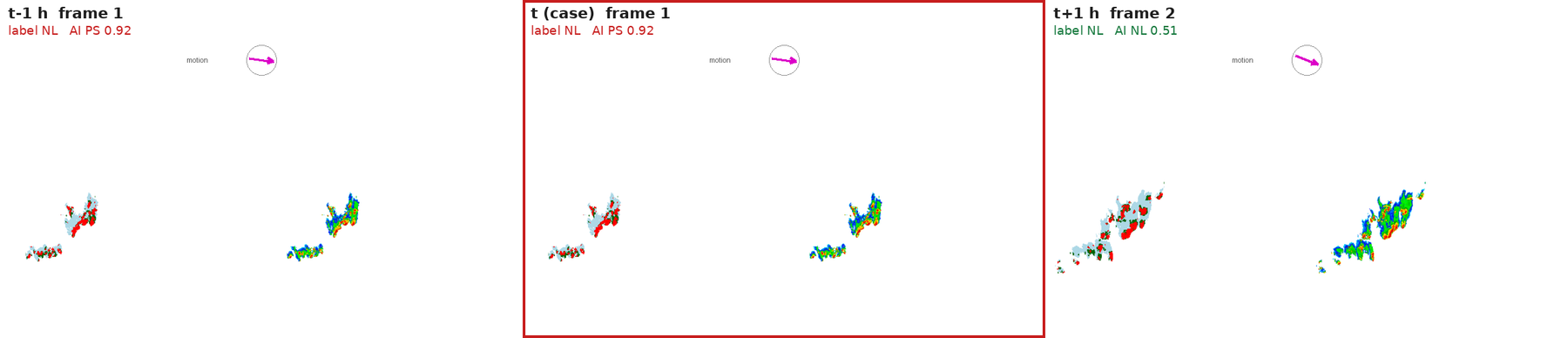
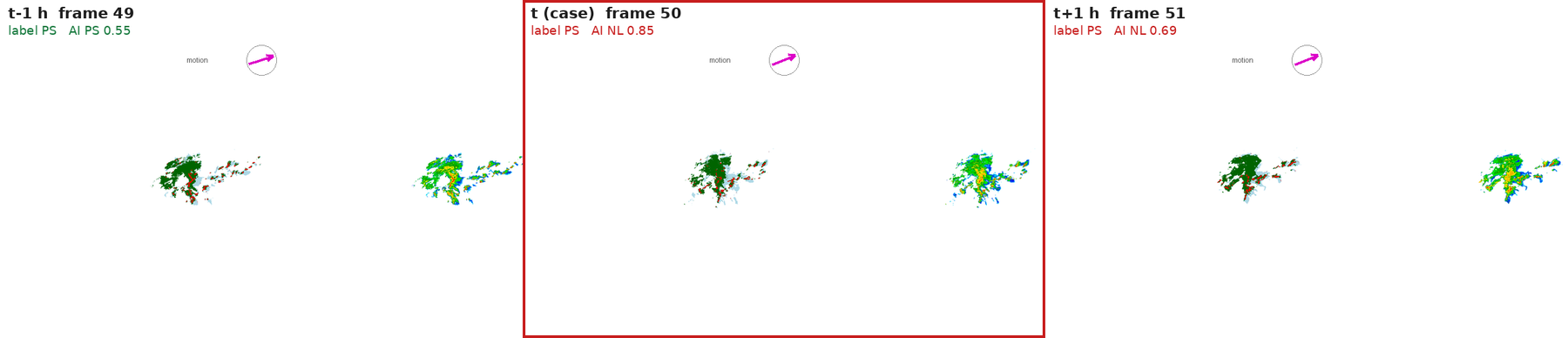
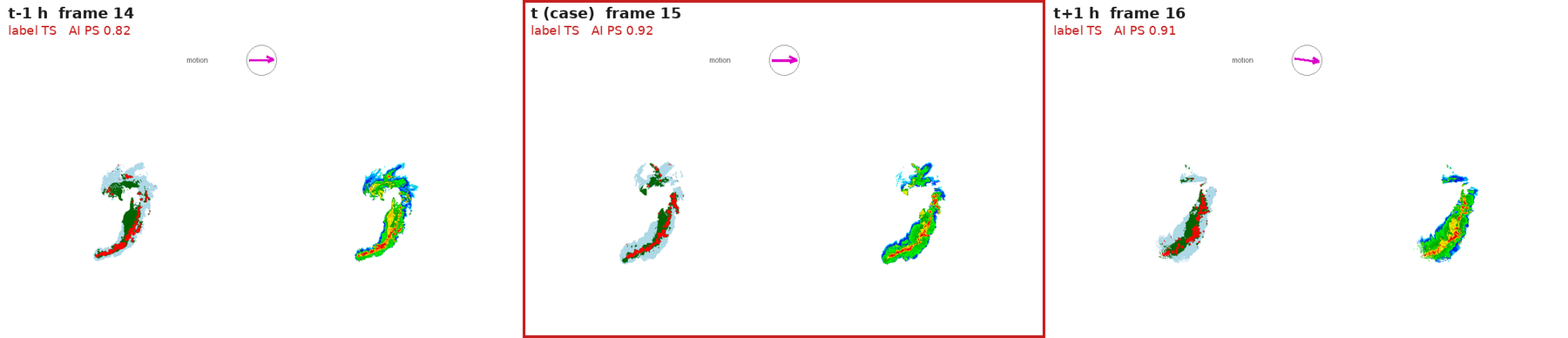
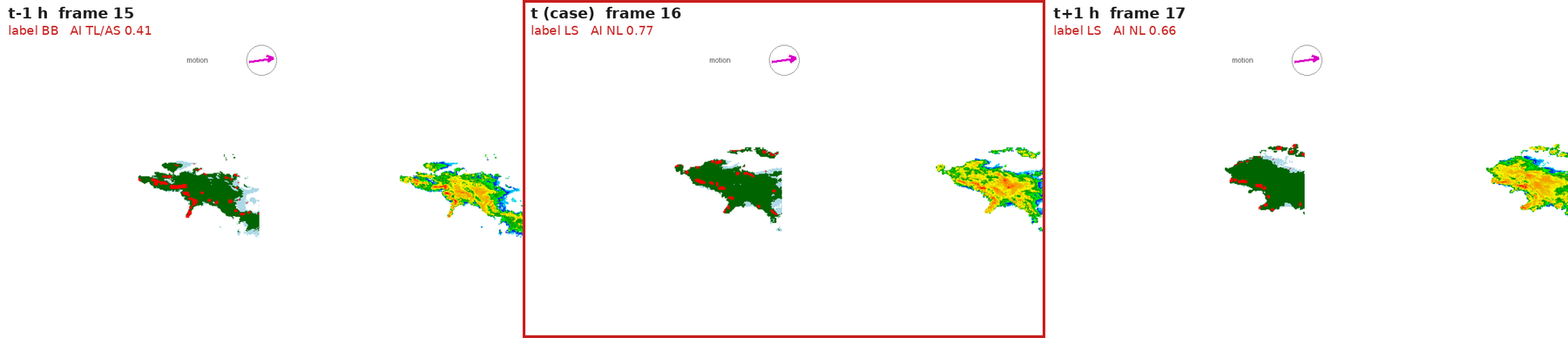
Model: Qwen3-VL vision encoder + linear head (the best arm of the 5-fold cross-validation). Every prediction comes from a model that never saw the frame's track. Of 18,328 frames, 5,261 are misclassified, 478 of them with high confidence (wrong class > 0.8, true class < 0.1). Below are 20 representative cases, grouped by type of confusion: in each group the model's most confident errors, from different systems, and, except for the 'transition' group, at least 2 h away from a linear/nonlinear label switch. Each strip shows the hour before, the case frame (red box) and the hour after, each annotated 'label / AI'. In every image the left panel is SL3D (red convective, green stratiform, light blue anvil), the right panel composite reflectivity, and the magenta arrow the motion.模型:Qwen3-VL 视觉编码器 + 线性分类头(5 折交叉验证中最好的一组)。每个预测都来自一个从未见过该 track 的模型。共 18,328 帧中判错 5,261 帧,其中高置信度严重错误(错误类别概率 >0.8,正确类别 <0.1)478 帧。下面按混淆类型挑了 20 个最有代表性的例子:每类取模型最有把握的错误、来自不同系统,除'转换期'一类外都避开了线性/非线性切换点前后 1 小时。每张图依次是前一小时、当前帧(红框)、后一小时,每帧标注'标签 / AI 预测'。图中左为 SL3D(红对流、绿层状、浅蓝砧云),右为组合反射率,品红箭头为运动方向。
Overall 1) About a third of the errors sit on the labeler's own class boundaries. For 30.7% of the 5,261 wrong frames, the predicted class is the label the labeler used on an adjacent frame; 41% among the high-confidence errors. There the labeler alternates between TS / PS / TL-AS while the model is often the more consistent one (cases 3, 13, 14, 16, 19). 2) Isolated one-frame labels are more often 'wrong'. Labels that differ from both neighbours make up 8.0% of the wrong frames but 4.6% of all frames; some are likely slips (case 19). 3) BB needs time. In a single frame BB and TL/AS look almost the same; the difference is whether new cells keep forming upstream, which a single-frame model cannot see (cases 1, 2). 4) Both ends of the life cycle disagree systematically. At genesis people wait until the structure is established before calling it linear; in decay they keep the earlier linear call. The model judges each frame on its own, so it switches early or gives up early (cases 5, 6, 9, 10, 12, 20). 5) What counts as a 'line' or the 'dominant structure': large multi-band complexes, or scattered cells inside a stratiform band, are read differently by people and the model (cases 7, 11); when the line is oblique to the motion, the PS / TS / TL-AS boundary depends on convention (cases 4, 15). 6) Some may be label problems worth re-checking (case 8: quite linear in the image, model and CNN agree on TL/AS, labeled NL). 'Clean' errors, more than 2 h from a linear/nonlinear switch and with a predicted class not used on neighbouring frames, are about 39% of all errors.总体判断 1)约三成错误落在标注员自己的类别边界上。在全部 5,261 个判错帧中,30.7% 的预测类别正是标注员在相邻一帧上用过的标签;高置信度严重错误中这一比例是 41%。这些帧上标注员自己在 TS / PS / TL-AS 之间来回切换,模型往往反而前后一致(例 3、13、14、16、19)。 2)孤立的单帧标签更容易'错'。和前后两帧都不同的单帧标签,在判错帧中占 8.0%,在全部帧中只占 4.6%,其中一部分很可能是标注笔误(例 19)。 3)BB 的问题是时间信息。BB 与 TL/AS 的单帧几何几乎相同,区别在于上游是否反复生成新单体,单帧模型看不到(例 1、2)。 4)生命期两端是系统性分歧。生成期人会等结构确立才判为线性,衰亡期人会沿用之前的线性判断,模型逐帧判断,于是提前或提早放弃(例 5、6、9、10、12、20)。 5)'主导结构'与'线'的定义:大型多带复合体、或带状层状区里零散的对流点,人和模型对'是否成线'的理解不同(例 7、11);线斜交于运动方向时,PS / TS / TL-AS 的边界依赖惯例(例 4、15)。 6)有些可能是标签本身的问题,值得复核(例 8:图像上相当线性,模型和 CNN 一致判 TL/AS,标注为 NL)。 真正'远离转换期、且预测类别不在邻近标签中'的干净错误,约占全部错误的 39%。
Confusions among all wrongly classified frames (5-fold cross-validation)混淆分布:5 折交叉验证中全部判错帧
label ↓ / AI →标签 ↓ / AI 预测 →
NL
TS
PS
LS
TL/AS
BB
NL
—
297
528
88
638
200
TS
171
—
273
7
195
20
PS
402
337
—
29
199
78
LS
68
6
34
—
26
28
TL/AS
440
177
167
22
—
213
BB
155
21
108
29
305
—
Rows: label. Columns: AI prediction. Darker = more frames.行:标签;列:AI 预测;颜色越深,帧数越多。
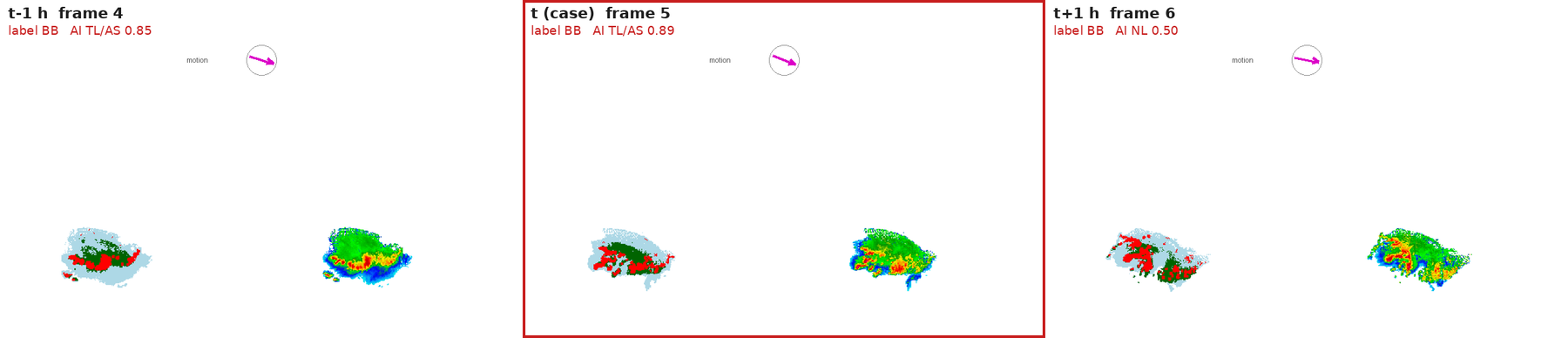
labels around 前后标签: BB BB BB BB BB BB BB BB BB AI around AI 预测 : NL PS TL/AS TL/AS TL/AS NL TL/AS TL/AS TL/AS
main convective line 317 km, continuity 1.0, 1 convective objects; convective centroid 8 km upstream of the stratiform centroid; stratiform: behind 42%, ahead 14%, beyond downstream end 0%, beyond upstream end 0%; line parallel to motion 0.96 (1 = parallel)主对流线 317 km,连续性 1.0,对流体 1 个;对流质心比层状质心靠上游 8 km;层状区:线后 42%、线前 14%、下游端外 0%、上游端外 0%;线与运动方向平行度 0.96(1 = 平行)
A compact system moving east-southeast, with convection forming a line along its southern edge and stratiform to the north. In this single frame the geometry is 'a line attached to one side of a large stratiform mass', which is the TL/AS definition. The labeler marked the whole track BB, presumably from new cells forming repeatedly at the western (upstream) end during playback, which a single image does not show. The model's predictions along this track jump between NL, PS and TL/AS, so it has no stable cue. The CNN also says TL/AS.紧凑系统向东南偏东移动,对流沿系统南缘成线、层状区在其北侧。单看这一帧,几何形态就是'线贴在一大片层状区的一侧',即 TL/AS 的定义。标注员把整条 track 都标成 BB,依据应当是回放中西端(上游)反复有新单体生成,这在单帧图像里看不出来。模型在这条 track 上的预测在 NL / PS / TL/AS 之间跳动,说明它没有稳定的线索。CNN 同样判成 TL/AS。
#2 · BB called TL/ASBB 被判为 TL/ASBB is defined by evolution in timeBB 由时间演化定义
2004 track 371, frame 152004 track 371 第 15 帧 ·
motion toward E at 13 m/s运动 向 E 移动,13 m/s ·
21 h from a linear/nonlinear switch距线性/非线性切换 21 小时
labels around 前后标签: TL/AS TL/AS TL/AS BB BB BB BB BB BB AI around AI 预测 : TL/AS TL/AS TL/AS TL/AS TL/AS TL/AS BB BB TL/AS
main convective line 309 km, continuity 0.97, 22 convective objects; convective centroid 65 km upstream of the stratiform centroid; stratiform: behind 7%, ahead 25%, beyond downstream end 54%, beyond upstream end 10%; line parallel to motion 0.98 (1 = parallel)主对流线 309 km,连续性 0.97,对流体 22 个;对流质心比层状质心靠上游 65 km;层状区:线后 7%、线前 25%、下游端外 54%、上游端外 10%;线与运动方向平行度 0.98(1 = 平行)
An east-west stratiform band with convection concentrated at the western (upstream) end; the convective centroid sits 65 km upstream of the stratiform centroid and 54% of the stratiform lies beyond the downstream end of the line: geometrically this is BB. The model still says TL/AS with 0.88. Another clue: the labeler marked the first frames of this track TL/AS and then switched to BB while the structure barely changed. BB and TL/AS differ mainly in whether convection keeps regenerating upstream; in a single frame their geometry is almost identical.东西向的长条层状带,对流集中在西端(上游),测得对流质心比层状质心靠上游 65 km、54% 的层状区位于线的下游端之外:几何上正是 BB。但模型仍以 0.88 判为 TL/AS。另一个线索是标注员自己在这条 track 的前几帧标 TL/AS、之后改标 BB,而图像结构变化不大:BB 与 TL/AS 的区分主要靠上游是否持续再生,单帧几何近乎相同。
#3 · TL/AS called PSTL/AS 被判为 PSlabeler alternates between two classes标注员相邻帧在两类间切换
2004 track 319, frame 22004 track 319 第 2 帧 ·
motion toward ENE at 11 m/s运动 向 ENE 移动,11 m/s ·
— h from a linear/nonlinear switch距线性/非线性切换 — 小时
labels around 前后标签: TL/AS TL/AS PS TL/AS TL/AS TL/AS AI around AI 预测 : PS PS PS TL/AS TL/AS TL/AS
main convective line 131 km, continuity 1.0, 4 convective objects; convective centroid 1 km upstream of the stratiform centroid; stratiform: behind 18%, ahead 10%, beyond downstream end 49%, beyond upstream end 17%; line parallel to motion 0.82 (1 = parallel)主对流线 131 km,连续性 1.0,对流体 4 个;对流质心比层状质心靠上游 1 km;层状区:线后 18%、线前 10%、下游端外 49%、上游端外 17%;线与运动方向平行度 0.82(1 = 平行)
A convective line on the western edge of the larger southern stratiform area, plus a separate cluster to the north. The label sequence is TL/AS, TL/AS, PS, TL/AS…: the labeler called the very next frame PS. The model says PS. This frame sits on the PS / TL-AS boundary, where the labeler's own call swings between the two.南侧较大的层状区西缘有一条对流线,北侧还有一个单独的团块。标注员的标签序列是 TL/AS → TL/AS → PS → TL/AS…,下一帧他自己就标了 PS。模型判 PS。这类帧处在 PS 与 TL/AS 的边界上,连标注员自己的判断都在两类之间摆动。
#4 · TL/AS called PSTL/AS 被判为 PSline oblique to motion: subtype boundary unclear线与运动方向斜交,子类边界模糊
2004 track 245, frame 202004 track 245 第 20 帧 ·
motion toward E at 18 m/s运动 向 E 移动,18 m/s ·
5 h from a linear/nonlinear switch距线性/非线性切换 5 小时
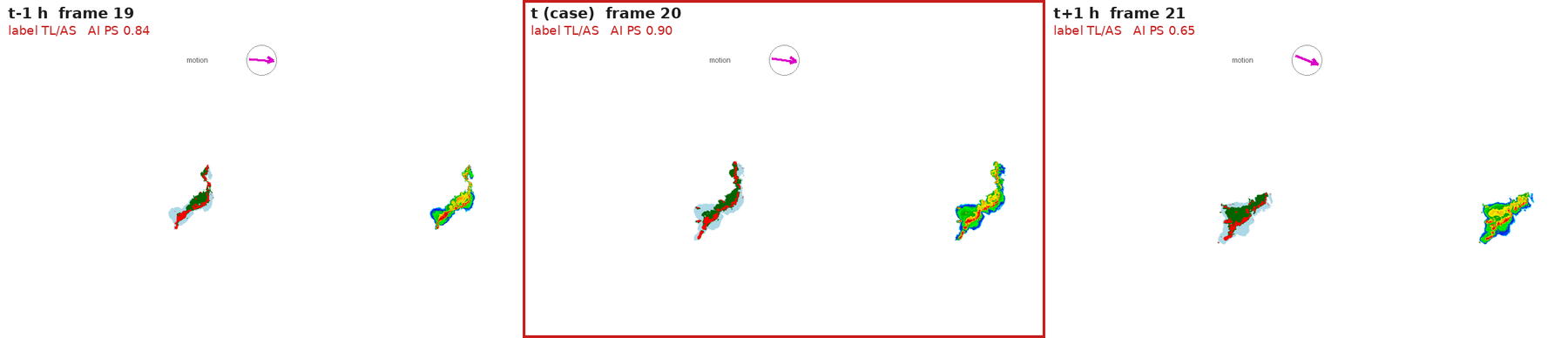
labels around 前后标签: TL/AS TL/AS TL/AS TL/AS TL/AS TL/AS TL/AS TL/AS TL/AS AI around AI 预测 : PS TS PS PS PS PS PS TS TL/AS
main convective line 512 km, continuity 1.0, 6 convective objects; convective centroid 19 km upstream of the stratiform centroid; stratiform: behind 42%, ahead 4%, beyond downstream end 25%, beyond upstream end 0%; line parallel to motion 0.6 (1 = parallel)主对流线 512 km,连续性 1.0,对流体 6 个;对流质心比层状质心靠上游 19 km;层状区:线后 42%、线前 4%、下游端外 25%、上游端外 0%;线与运动方向平行度 0.6(1 = 平行)
A narrow SW-NE line with stratiform along its northwest side, oblique to the motion (east). 'Stratiform lying parallel along the line' reads as PS; the labeler marked the whole track TL/AS, while the model (and the CNN) say PS for almost all of it. This is a disagreement of definition: when the line is oblique to motion and the stratiform runs along it, the PS / TL-AS boundary depends on personal convention.西南-东北走向的窄线,层状区沿着线的西北侧分布,线与运动方向(向东)斜交。按'层状区沿线平行分布'看像 PS,标注员整条 track 标 TL/AS,模型几乎整条都标 PS,CNN 也是 PS。这是定义层面的分歧:当线斜交于运动方向、层状区又沿线分布时,PS 和 TL/AS 的边界依赖个人惯例。
#5 · TL/AS called NLTL/AS 被判为 NLgenesis / decay: humans hold or delay the call生成/衰亡阶段:人保持或推迟判断
2004 track 29, frame 112004 track 29 第 11 帧 ·
motion toward E at 28 m/s运动 向 E 移动,28 m/s ·
8 h from a linear/nonlinear switch距线性/非线性切换 8 小时
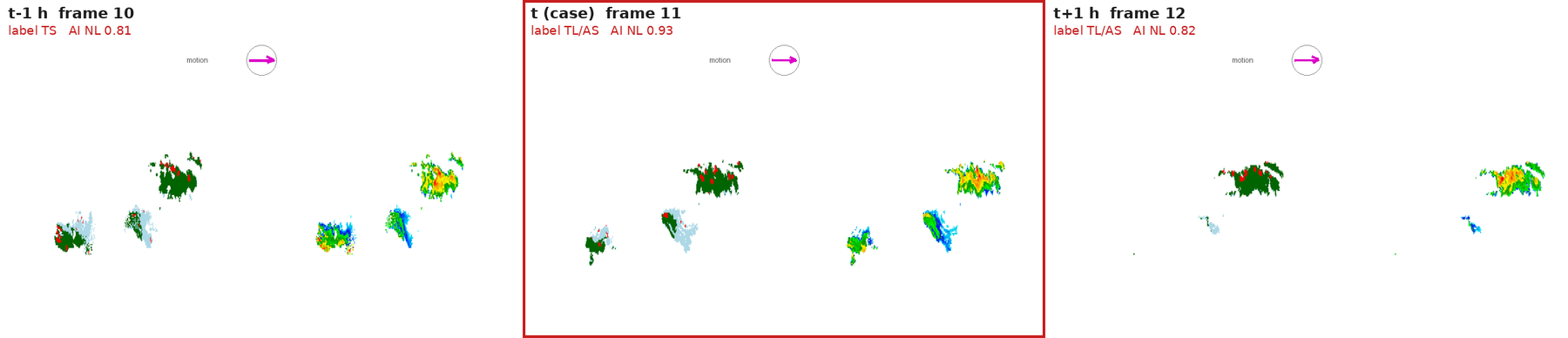
labels around 前后标签: LS LS LS TS TL/AS TL/AS AI around AI 预测 : LS NL LS NL NL NL
main convective line 57 km, continuity 0.75, 8 convective objects; convective centroid 76 km downstream of the stratiform centroid; stratiform: behind 6%, ahead 16%, beyond downstream end 8%, beyond upstream end 69%; line parallel to motion 0.46 (1 = parallel)主对流线 57 km,连续性 0.75,对流体 8 个;对流质心比层状质心靠下游 76 km;层状区:线后 6%、线前 16%、下游端外 8%、上游端外 69%;线与运动方向平行度 0.46(1 = 平行)
Several scattered small clusters; the northern one is mostly stratiform with only isolated convection (main line 57 km, continuity 0.75, 8 separate convective objects). The labels change quickly: LS, LS, LS, TS, TL/AS. Both the model and the CNN say NL. It looks like a decaying stage where the labeler kept an earlier linear call (a 'holding' habit Logan described himself).几个分散的小团块,北侧主体以层状为主,只有零星对流;测得主对流线仅 57 km、连续性 0.75、8 个分离的对流体。标注员的标签在 LS → LS → LS → TS → TL/AS 之间快速变化。模型与 CNN 都判 NL。这更像衰亡阶段,标注员可能沿用了之前的线性判断(Logan 自己描述过这种'保持'习惯)。
#6 · TL/AS called NLTL/AS 被判为 NLgenesis / decay: humans hold or delay the call生成/衰亡阶段:人保持或推迟判断
2005 track 174, frame 122005 track 174 第 12 帧 ·
motion toward ENE at nan m/s运动 未知 ·
6 h from a linear/nonlinear switch距线性/非线性切换 6 小时
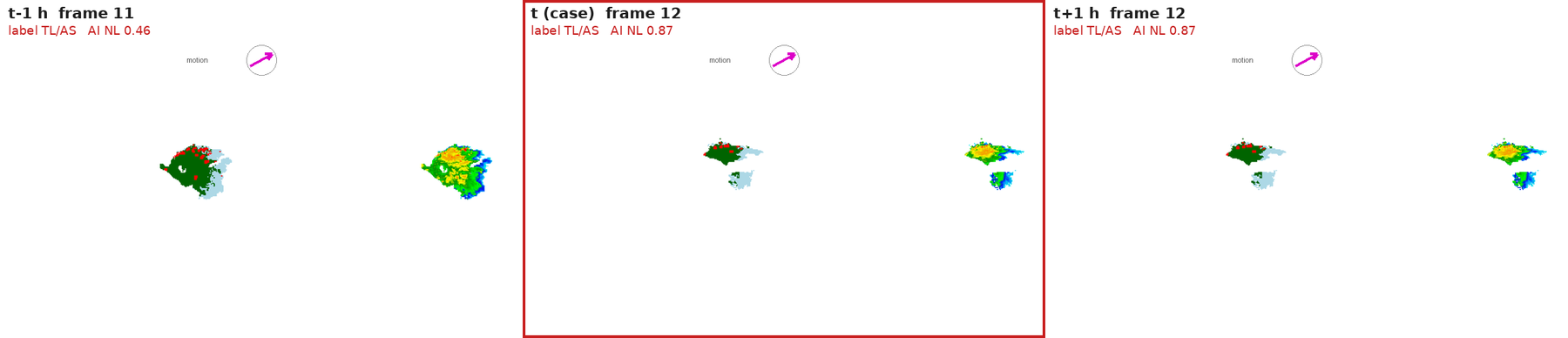
labels around 前后标签: TL/AS TS TS TL/AS TL/AS AI around AI 预测 : TS TS TS NL NL
main convective line 101 km, continuity 1.0, 2 convective objects; convective centroid 9 km downstream of the stratiform centroid; stratiform: behind 49%, ahead 1%, beyond downstream end 27%, beyond upstream end 8%; line parallel to motion 0.81 (1 = parallel)主对流线 101 km,连续性 1.0,对流体 2 个;对流质心比层状质心靠下游 9 km;层状区:线后 49%、线前 1%、下游端外 27%、上游端外 8%;线与运动方向平行度 0.81(1 = 平行)
A very small, weak system with only scattered convection on its northern edge, at the last frame of the track. The labeler: TS, TS, TL/AS; model and CNN: NL. At this size there is hardly a line to see; an ambiguous end-of-life frame.很小、很弱的系统,北缘只有零散对流,track 也到了最后一帧。标注员 TS → TS → TL/AS,模型和 CNN 都判 NL。在这个尺度上几乎看不出线,属于生命末期的模糊帧。
#7 · NL called TL/ASNL 被判为 TL/ASlarge multi-band complex: what is 'dominant'大型多带复合体:'主导结构'判断
2005 track 66, frame 52005 track 66 第 5 帧 ·
motion toward E at 7 m/s运动 向 E 移动,7 m/s ·
2 h from a linear/nonlinear switch距线性/非线性切换 2 小时
labels around 前后标签: NL NL NL NL NL NL NL PS NL AI around AI 预测 : NL NL NL TL/AS TL/AS TL/AS NL PS NL
main convective line 291 km, continuity 1.0, 15 convective objects; convective centroid 62 km downstream of the stratiform centroid; stratiform: behind 5%, ahead 38%, beyond downstream end 30%, beyond upstream end 4%; line parallel to motion 0.96 (1 = parallel)主对流线 291 km,连续性 1.0,对流体 15 个;对流质心比层状质心靠下游 62 km;层状区:线后 5%、线前 38%、下游端外 30%、上游端外 4%;线与运动方向平行度 0.96(1 = 平行)
A large, slow eastward-moving complex with convective bands along its northern edge and in the south, and a broad stratiform region; the measured main line is 291 km long and continuous. The labeler called the whole track NL (one frame PS), probably seeing a multi-banded, disorganized whole; the model and the CNN latch on to the longest convective band and say TL/AS. The disagreement is about what counts as the dominant structure.缓慢东移的大型复合体,北缘和南部各有对流带,层状区广阔。测得主对流线长 291 km、连续。标注员把整条 track 判为 NL(只有一帧 PS),可能是把它看作多带、组织混乱的整体;模型和 CNN 都抓住了其中最长的一条对流带,判成 TL/AS。分歧在于'主导结构'怎么认定。
#8 · NL called TL/ASNL 被判为 TL/ASpossible labeling error疑似标注错误
2004 track 138, frame 92004 track 138 第 9 帧 ·
motion toward ESE at 14 m/s运动 向 ESE 移动,14 m/s ·
— h from a linear/nonlinear switch距线性/非线性切换 — 小时
labels around 前后标签: NL NL NL NL NL NL NL NL AI around AI 预测 : TL/AS TL/AS TL/AS TL/AS TL/AS TL/AS TS NL
main convective line 174 km, continuity 1.0, 11 convective objects; convective centroid 2 km upstream of the stratiform centroid; stratiform: behind 44%, ahead 4%, beyond downstream end 22%, beyond upstream end 26%; line parallel to motion 0.78 (1 = parallel)主对流线 174 km,连续性 1.0,对流体 11 个;对流质心比层状质心靠上游 2 km;层状区:线后 44%、线前 4%、下游端外 22%、上游端外 26%;线与运动方向平行度 0.78(1 = 平行)
A clear convective arc along the southwest-south edge of a large stratiform area, moving east-southeast. The image looks quite linear and both the model and the CNN consistently say TL/AS, while the labeler marked the whole track NL. Worth re-checking: either a stricter requirement for a continuous line, or a labeling error.大片层状区的西南-南缘有一条清楚的对流弧线,系统向东南偏东移动。从图像看相当线性,模型和 CNN 都一致判为 TL/AS,而标注员整条 track 都标 NL。这是值得复核的标注:可能是标注员对'连续线'要求更严,也可能是错标。
#9 · NL called PSNL 被判为 PSgenesis / decay: humans hold or delay the call生成/衰亡阶段:人保持或推迟判断
2005 track 29, frame 262005 track 29 第 26 帧 ·
motion toward NE at 10 m/s运动 向 NE 移动,10 m/s ·
17 h from a linear/nonlinear switch距线性/非线性切换 17 小时
labels around 前后标签: NL NL NL NL NL NL NL NL AI around AI 预测 : NL NL NL PS PS NL NL NL
main convective line 261 km, continuity 0.88, 15 convective objects; convective centroid 130 km upstream of the stratiform centroid; stratiform: behind 2%, ahead 5%, beyond downstream end 89%, beyond upstream end 0%; line parallel to motion 0.97 (1 = parallel)主对流线 261 km,连续性 0.88,对流体 15 个;对流质心比层状质心靠上游 130 km;层状区:线后 2%、线前 5%、下游端外 89%、上游端外 0%;线与运动方向平行度 0.97(1 = 平行)
A decaying broad stratiform area with a narrow, weak, line-like band of cells at its southwestern end, the stratiform extending downstream. Labeled NL; model and CNN say PS. The band is weak and short, so NL is defensible; the model is too sensitive to 'elongated shape + stratiform along it'.衰减中的宽层状区,西南端有一段较窄、排列成线的弱对流,层状区沿下游延伸。标注员标 NL,模型和 CNN 都判 PS。线很弱、很短,NL 的判断说得通;模型对'细长形态 + 沿线层状区'过于敏感。
#10 · NL called PSNL 被判为 PSgenesis / decay: humans hold or delay the call生成/衰亡阶段:人保持或推迟判断
2006 track 265, frame 12006 track 265 第 1 帧 ·
motion toward E at 15 m/s运动 向 E 移动,15 m/s ·
3 h from a linear/nonlinear switch距线性/非线性切换 3 小时
labels around 前后标签: NL NL NL NL PS AI around AI 预测 : PS NL PS PS PS
main convective line 245 km, continuity 1.0, 5 convective objects; convective centroid 41 km downstream of the stratiform centroid; stratiform: behind 16%, ahead 4%, beyond downstream end 0%, beyond upstream end 45%; line parallel to motion 0.64 (1 = parallel)主对流线 245 km,连续性 1.0,对流体 5 个;对流质心比层状质心靠下游 41 km;层状区:线后 16%、线前 4%、下游端外 0%、上游端外 45%;线与运动方向平行度 0.64(1 = 平行)
First frame of the track: a continuous SW-NE convective line of about 245 km with almost no stratiform. The labeler marked the first frames NL and switched to PS at frame 5; the model says PS from the start. At genesis, people tend to wait until the organization is established before calling it linear.track 的第一帧:一条西南-东北走向、约 245 km 的连续对流线,几乎没有层状区。标注员前几帧标 NL、到第 5 帧才标 PS;模型从一开始就判 PS。人在系统生成阶段倾向于等组织结构建立后才判为线性。
#11 · PS called NLPS 被判为 NLlarge multi-band complex: what is 'dominant'大型多带复合体:'主导结构'判断
2004 track 404, frame 182004 track 404 第 18 帧 ·
motion toward ENE at 21 m/s运动 向 ENE 移动,21 m/s ·
2 h from a linear/nonlinear switch距线性/非线性切换 2 小时
labels around 前后标签: NL NL PS PS PS PS PS NL NL AI around AI 预测 : NL NL NL PS NL NL NL NL NL
main convective line 178 km, continuity 0.78, 36 convective objects; convective centroid 21 km upstream of the stratiform centroid; stratiform: behind 9%, ahead 1%, beyond downstream end 50%, beyond upstream end 39%; line parallel to motion 0.9 (1 = parallel)主对流线 178 km,连续性 0.78,对流体 36 个;对流质心比层状质心靠上游 21 km;层状区:线后 9%、线前 1%、下游端外 50%、上游端外 39%;线与运动方向平行度 0.9(1 = 平行)
A long SW-NE stratiform band with many scattered weak convective points embedded (36 objects, continuity 0.78). The labeler judged the band organization and said PS; the model sees convection that does not form a continuous line and says NL (as does the CNN). The question is whether 'line' means the arrangement of convective cells or the shape of the whole precipitation band (the guidance says to judge the convective region).西南-东北向的长条层状带,里面嵌着很多零散的弱对流点(36 个对流体,连续性 0.78)。标注员看整体带状组织判 PS;模型看到对流并不成连续线,判 NL,CNN 也判 NL。分歧在于'线'指对流单体的排列,还是整个降水带的形状(指南要求看对流区)。
#12 · PS called NLPS 被判为 NLgenesis / decay: humans hold or delay the call生成/衰亡阶段:人保持或推迟判断
2004 track 303, frame 502004 track 303 第 50 帧 ·
motion toward ENE at 22 m/s运动 向 ENE 移动,22 m/s ·
2 h from a linear/nonlinear switch距线性/非线性切换 2 小时
labels around 前后标签: NL NL TS PS PS PS PS PS TS AI around AI 预测 : NL NL NL PS NL NL NL NL NL
main convective line 238 km, continuity 0.87, 24 convective objects; convective centroid 46 km downstream of the stratiform centroid; stratiform: behind 16%, ahead 19%, beyond downstream end 50%, beyond upstream end 8%; line parallel to motion 0.46 (1 = parallel)主对流线 238 km,连续性 0.87,对流体 24 个;对流质心比层状质心靠下游 46 km;层状区:线后 16%、线前 19%、下游端外 50%、上游端外 8%;线与运动方向平行度 0.46(1 = 平行)
Frame 50, late in the life cycle: a few small clusters with scattered convection. Still labeled PS; the model says NL. The image looks more like NL: a 'holding' call during decay.第 50 帧,系统已进入晚期:几个小团块、对流零散。标注员仍标 PS,模型判 NL。看图更像 NL,属于衰亡期的'保持'判断。
#13 · PS called TSPS 被判为 TSlabeler alternates between two classes标注员相邻帧在两类间切换
2005 track 118, frame 132005 track 118 第 13 帧 ·
motion toward NE at 10 m/s运动 向 NE 移动,10 m/s ·
2 h from a linear/nonlinear switch距线性/非线性切换 2 小时
labels around 前后标签: TL/AS NL TL/AS TL/AS PS TS TS TS TS AI around AI 预测 : NL NL TL/AS TS TS TS TS TS TS
main convective line 315 km, continuity 0.93, 5 convective objects; convective centroid 3 km downstream of the stratiform centroid; stratiform: behind 64%, ahead 2%, beyond downstream end 7%, beyond upstream end 7%; line parallel to motion 0.93 (1 = parallel)主对流线 315 km,连续性 0.93,对流体 5 个;对流质心比层状质心靠下游 3 km;层状区:线后 64%、线前 2%、下游端外 7%、上游端外 7%;线与运动方向平行度 0.93(1 = 平行)
A convective line on the eastern edge (motion northeast) of a large stratiform area, with 64% of the stratiform behind it: geometrically TS. The labeler called this frame PS and switched to TS from the next frame on; the model says TS already here. The model simply switches subtype one hour earlier than the labeler.对流线位于大片层状区的东缘(移动方向是东北),层状区 64% 在线后方,几何上就是 TS。标注员这一帧标 PS,下一帧起改标 TS;模型从这一帧就判 TS。模型只是比标注员早一小时切换子类。
#14 · PS called TSPS 被判为 TSlabeler alternates between two classes标注员相邻帧在两类间切换
2005 track 148, frame 232005 track 148 第 23 帧 ·
motion toward NE at 22 m/s运动 向 NE 移动,22 m/s ·
19 h from a linear/nonlinear switch距线性/非线性切换 19 小时
labels around 前后标签: TL/AS TL/AS PS PS PS TS TS PS PS AI around AI 预测 : TL/AS TL/AS TS TS TS TS TS TS TS
main convective line 317 km, continuity 1.0, 12 convective objects; convective centroid 23 km upstream of the stratiform centroid; stratiform: behind 64%, ahead 0%, beyond downstream end 3%, beyond upstream end 27%; line parallel to motion 0.77 (1 = parallel)主对流线 317 km,连续性 1.0,对流体 12 个;对流质心比层状质心靠上游 23 km;层状区:线后 64%、线前 0%、下游端外 3%、上游端外 27%;线与运动方向平行度 0.77(1 = 平行)
A convective line on the southeastern edge with 64% of the stratiform behind it, geometrically leaning TS. The label sequence is PS, PS, PS, TS, TS, PS, PS, alternating between neighbouring frames, while the model says TS steadily. Such 'errors' mostly reflect inconsistency in the labels themselves.对流线在东南缘,层状区 64% 在线后方,几何上偏 TS。标注员的序列是 PS → PS → PS → TS → TS → PS → PS,在相邻帧间来回切换;模型整段稳定判 TS。这类'错误'主要反映标签本身的不一致。
#15 · TS called PSTS 被判为 PSline oblique to motion: subtype boundary unclear线与运动方向斜交,子类边界模糊
2004 track 114, frame 152004 track 114 第 15 帧 ·
motion toward E at 19 m/s运动 向 E 移动,19 m/s ·
5 h from a linear/nonlinear switch距线性/非线性切换 5 小时
labels around 前后标签: TS TS TS TS TS TS TS TS TS AI around AI 预测 : TS TS PS PS PS PS PS TS TS
main convective line 550 km, continuity 0.99, 6 convective objects; convective centroid 8 km downstream of the stratiform centroid; stratiform: behind 22%, ahead 13%, beyond downstream end 20%, beyond upstream end 3%; line parallel to motion 0.62 (1 = parallel)主对流线 550 km,连续性 0.99,对流体 6 个;对流质心比层状质心靠下游 8 km;层状区:线后 22%、线前 13%、下游端外 20%、上游端外 3%;线与运动方向平行度 0.62(1 = 平行)
A curved, bow-shaped SW-NE convective line with stratiform mainly along the northwest side of its northern part, oblique to the motion (east). Labeled TS for the whole track; the model (and the CNN) say PS for five frames in the middle. The more oblique the line is to the motion, the harder it is to tell 'stratiform behind' from 'stratiform alongside'.弯曲的弓形对流线,走向西南-东北,层状区主要沿北段的西北侧分布,线与运动方向(向东)斜交。标注员整条 track 标 TS,模型中间 5 帧判 PS,CNN 也判 PS。线越斜交于运动方向,'层状区在后方'和'层状区沿线分布'就越难区分。
#16 · TS called PSTS 被判为 PSlabeler alternates between two classes标注员相邻帧在两类间切换
2004 track 153, frame 62004 track 153 第 6 帧 ·
motion toward E at 17 m/s运动 向 E 移动,17 m/s ·
2 h from a linear/nonlinear switch距线性/非线性切换 2 小时
labels around 前后标签: NL NL TS PS TS TS TS TS NL AI around AI 预测 : NL NL PS PS PS PS TS TS TS
main convective line 351 km, continuity 1.0, 10 convective objects; convective centroid 42 km upstream of the stratiform centroid; stratiform: behind 28%, ahead 17%, beyond downstream end 46%, beyond upstream end 2%; line parallel to motion 0.56 (1 = parallel)主对流线 351 km,连续性 1.0,对流体 10 个;对流质心比层状质心靠上游 42 km;层状区:线后 28%、线前 17%、下游端外 46%、上游端外 2%;线与运动方向平行度 0.56(1 = 平行)
A SW-NE convective line in the west with a second segment to the east. Label sequence NL, NL, TS, PS, TS…: the labeler called the previous frame PS himself; the model and the CNN say PS.西段是一条西南-东北走向的对流线,东侧另有一段。标注员的序列 NL → NL → TS → PS → TS…,前一帧他自己标了 PS;模型和 CNN 都判 PS。
#17 · LS called NLLS 被判为 NLrare class + image problems稀有类 + 图像问题
2004 track 29, frame 82004 track 29 第 8 帧 ·
motion toward ESE at 5 m/s运动 向 ESE 移动,5 m/s ·
5 h from a linear/nonlinear switch距线性/非线性切换 5 小时
labels around 前后标签: LS LS LS LS LS LS TS TL/AS TL/AS AI around AI 预测 : LS TL/AS TS LS NL LS NL NL NL
main convective line 126 km, continuity 0.94, 10 convective objects; convective centroid 7 km upstream of the stratiform centroid; stratiform: behind 1%, ahead 26%, beyond downstream end 64%, beyond upstream end 6%; line parallel to motion 0.9 (1 = parallel)主对流线 126 km,连续性 0.94,对流体 10 个;对流质心比层状质心靠上游 7 km;层状区:线后 1%、线前 26%、下游端外 64%、上游端外 6%;线与运动方向平行度 0.9(1 = 平行)
Moving slowly east-southeast (5 m/s), with convection on the western edge of a large stratiform area, i.e. stratiform ahead of the convection, hence LS. But the convection is a thin, broken rim, there are several separate clusters to the north, and a straight edge cuts through the stratiform, which looks like a radar-coverage boundary in the data. The model says NL (0.77), LS second (0.15). LS has only 262 frames in the whole dataset, here compounded by a thin rim and a data artefact.缓慢向东南偏东移动(5 m/s),对流位于西南侧大块层状区的西缘,层状区在对流前方,所以标注为 LS。但对流只是一条很薄、不连续的边,北面还有几个分离的团块;层状区中还能看到一条笔直的边界,像是雷达覆盖造成的数据断面。模型判 NL(0.77),LS 排第二(0.15)。LS 全库只有 262 帧,又叠加了薄对流边和数据伪迹。
#18 · LS called NLLS 被判为 NLrare class + image problems稀有类 + 图像问题
2006 track 275, frame 162006 track 275 第 16 帧 ·
motion toward E at 19 m/s运动 向 E 移动,19 m/s ·
2 h from a linear/nonlinear switch距线性/非线性切换 2 小时
labels around 前后标签: NL NL BB BB LS LS LS NL NL AI around AI 预测 : NL NL NL TL/AS NL NL NL NL NL
main convective line 67 km, continuity 1.0, 15 convective objects; convective centroid 39 km upstream of the stratiform centroid; stratiform: behind 2%, ahead 14%, beyond downstream end 64%, beyond upstream end 20%; line parallel to motion 0.76 (1 = parallel)主对流线 67 km,连续性 1.0,对流体 15 个;对流质心比层状质心靠上游 39 km;层状区:线后 2%、线前 14%、下游端外 64%、上游端外 20%;线与运动方向平行度 0.76(1 = 平行)
A large stratiform area with scattered convection along its western and southern edges; the east side of the system is cut off by the edge of the plotted domain (a straight vertical boundary). Label sequence NL, NL, BB, BB, LS, LS, LS, NL: three class changes within a few hours. Model and CNN say NL. A truncated view plus unstable labels make such frames almost unlearnable.大片层状区,西缘和南缘有零散对流;系统东侧被图幅边缘截断(右侧是一条笔直的边)。标注员的序列 NL → NL → BB → BB → LS → LS → LS → NL,在短时间内三次换类。模型判 NL,CNN 也判 NL。截断的视野和不稳定的标签让这类帧几乎无法学习。
#19 · Transition frame转换期帧labeler alternates between two classes标注员相邻帧在两类间切换
2004 track 161, frame 102004 track 161 第 10 帧 ·
motion toward ENE at 18 m/s运动 向 ENE 移动,18 m/s ·
0 h from a linear/nonlinear switch距线性/非线性切换 0 小时
labels around 前后标签: NL NL TS TS NL TS TS TS TS AI around AI 预测 : PS TS TS TS TS TS TS TS TS
main convective line 250 km, continuity 1.0, 19 convective objects; convective centroid 19 km upstream of the stratiform centroid; stratiform: behind 24%, ahead 9%, beyond downstream end 53%, beyond upstream end 9%; line parallel to motion 0.13 (1 = parallel)主对流线 250 km,连续性 1.0,对流体 19 个;对流质心比层状质心靠上游 19 km;层状区:线后 24%、线前 9%、下游端外 53%、上游端外 9%;线与运动方向平行度 0.13(1 = 平行)
The label sequence is TS, TS, NL, TS, TS: a single NL frame inside a run of TS while the structure is continuous. The model and the CNN say TS throughout. Isolated one-frame labels like this are likely slips; among wrongly classified frames they are almost twice as common as among all frames (8.0% vs 4.6%).标注员的序列是 TS → TS → NL → TS → TS:在一串 TS 中间夹了一帧 NL,而图像结构前后连续。模型和 CNN 都稳定判 TS。这种孤立的单帧标签很可能是标注笔误;统计上,单帧孤立标签在判错帧中的比例是全体帧的近两倍(8.0% vs 4.6%)。
#20 · Transition frame转换期帧genesis / decay: humans hold or delay the call生成/衰亡阶段:人保持或推迟判断
2004 track 82, frame 42004 track 82 第 4 帧 ·
motion toward NNE at 11 m/s运动 向 NNE 移动,11 m/s ·
0 h from a linear/nonlinear switch距线性/非线性切换 0 小时
labels around 前后标签: NL NL NL NL TS TS TS TS AI around AI 预测 : PS PS TS TS TS TS TS TS
main convective line 416 km, continuity 0.92, 9 convective objects; convective centroid 33 km upstream of the stratiform centroid; stratiform: behind 63%, ahead 4%, beyond downstream end 17%, beyond upstream end 4%; line parallel to motion 0.99 (1 = parallel)主对流线 416 km,连续性 0.92,对流体 9 个;对流质心比层状质心靠上游 33 km;层状区:线后 63%、线前 4%、下游端外 17%、上游端外 4%;线与运动方向平行度 0.99(1 = 平行)
A transition: the line is forming and stratiform begins to appear behind it. The labeler marked the first 4 frames NL and TS from frame 5; the model switches to TS 1-2 hours earlier. As in case 10, people tend to wait until the structure is established.转换期:线正在形成,层状区开始出现在线后方。标注员前 4 帧都标 NL、第 5 帧起标 TS;模型提前 1–2 小时就判为 TS。和第 10 例一样,人倾向于等结构确立再改判。
The analyses are my inferences from the images, the neighbouring labels and the automatically measured geometry, meant for discussion; review by the labelers and domain experts takes precedence.原因分析是我根据图像、前后帧标签和自动测得的几何量写的推断,供讨论;最终以标注员和领域专家的复核为准。